




By: Zoran Krešić
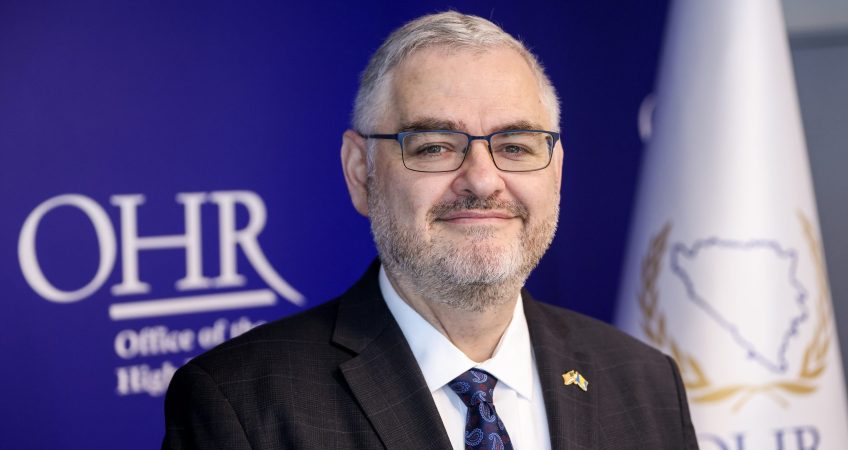
Louis Crishock is the second American, after Raffi Gregorian in 2008, to temporarily take charge of the Office of the High Representative (OHR) in Bosnia and Herzegovina. However, he is the first to do so with a full mandate and all accompanying powers, including the Bonn powers. While consultations continue between the EU member states and the United States on a permanent successor to Christian Schmidt, who has left Bosnia and Herzegovina, Crishock, who also remains the Brčko Supervisor, is giving his first interview exclusively to Večernji list. We spoke with him about his mandate, differing views within the Peace Implementation Council, the future of the OHR, and the responsibility of Bosnia and Herzegovina’s local political actors.
Večernji list: There are several questions that need to be clarified from the outset. Are you the High Representative with the full scope of authority? In other words, were you appointed in accordance with the prescribed procedure, and do you possess the Bonn Powers?
Louis Crishock: I was appointed High Representative with the full mandate, authority, and responsibilities of the office. I exercise all the powers vested in the High Representative, including the Bonn Powers.
The term “acting” has political rather than legal significance. It is a political characterization reflecting the understanding of the Peace Implementation Council Steering Board that my appointment is interim and will remain in effect only until a new High Representative is appointed.
Večernji list: Do you expect an agreement on your successor to be reached by 14 July, particularly in light of the interesting comments made by Commissioner Kaja Kallas, who said she had expected a consensus to be achieved before her visit to Bosnia and Herzegovina?
Louis Crishock: I very much hope consensus can be reached as soon as possible, but that is ultimately a matter for the governments involved. It would not be appropriate for me to speculate on the discussions currently taking place among the members of the Peace Implementation Council Steering Board.
What is important is that the Office of the High Representative continues its operations without interruption. I will continue carrying out the mandate with the full authority entrusted to me until the Peace Implementation Council Steering Board decides otherwise.
Večernji list: To what extent do differing positions and divisions among the members of the Peace Implementation Council, particularly between the European Union and the United States, weaken the role of the Office of the High Representative?
Louis Crishock: It is natural that members of the Peace Implementation Council Steering Board have different views on certain issues. That is part of any engaged international discussion. What matters more than any differences is that they all share common fundamental objectives: full implementation of the Dayton Peace Agreement and the preservation of Bosnia and Herzegovina’s peace, stability, sovereignty, and territorial integrity.
I do not believe that differing views, as such, weaken the Office of the High Representative in any way. The OHR’s mandate is grounded in the Dayton Peace Agreement, and my responsibility is to carry out that mandate impartially, consistently, and in the interest of all citizens of Bosnia and Herzegovina.
Peace Implementation Council Steering Board members recognize that unity is critical and they remain committed to preserving that unity. A coherent international approach contributes to an environment in which reforms can advance, institutions can function effectively, and the constitutional order is fully respected.
Večernji list: As a diplomat from the United States, your home country’s current administration has emphasized three key priorities regarding Bosnia and Herzegovina: that the new High Representative should maintain open communication with all parties in the country, that the era of “nation-building” in the Balkans is over, and that OHR supervision should be gradually brought to an end. In your view, how far are we from achieving these objectives?
Louis Crishock: As the High Representative, I am guided by the mandate deriving from the Dayton Peace Agreement and entrusted to me by the Peace Implementation Council Steering Board. My responsibility is to implement the civilian aspects of the Dayton Peace Agreement impartially and in accordance with that mandate, rather than the policies of any individual country.
Open communication with all political actors is essential, and I fully agree that dialogue must remain open, direct, and honest. It is our job to talk to everyone. In line with the Dayton Peace Agreement, we encourage political dialogue at every level but also expect them to be framed in full respect for the Constitution, the rule of law, and the institutions of Bosnia and Herzegovina.
I believe we all share the same objective: the Office of the High Representative was never intended to be a permanent feature of Bosnia and Herzegovina’s political landscape. The ultimate goal has always been a stable, functional, prosperous, and self-sustaining Bosnia and Herzegovina, with institutions capable of assuming full responsibility for the country’s future.
Until that point is reached, the OHR remains a necessary part of the international framework supporting peace, stability, and the constitutional order of Bosnia and Herzegovina and helping its authority to reach those goals.
Večernji list: How do you respond to calls for the long-term presence of the Office of the High Representative and to suggestions that a form of mutual dependency has developed between certain domestic political actors and the international diplomats operating in Bosnia and Herzegovina?
Louis Crishock: I do not believe that Bosnia and Herzegovina benefits from dependency—whether on the Office of the High Representative or any other international actor. The country’s future ultimately depends on its citizens, their political leaders, and institutions. Domestic authorities must take ownership of reforms, strengthen institutions, and demonstrate a willingness to reach the compromises that are essential in every democratic society.
The role of the OHR is not to replace domestic responsibility or provide solutions that should be delivered by elected leaders. OHR’s role is to safeguard the implementation of the Dayton Peace Agreement, protect the constitutional framework, and help preserve peace and stability should they be at risk.
The objective has always been clear: a Bosnia and Herzegovina whose institutions are fully capable of exercising their responsibilities without the continued presence of the Office of the High Representative. Achieving that goal depends on meeting the objectives and conditions of the 5+2 Agenda and, above all, on the commitment of domestic leaders to uphold the rule of law, respect the constitutional order, and act in the interests of all citizens.