


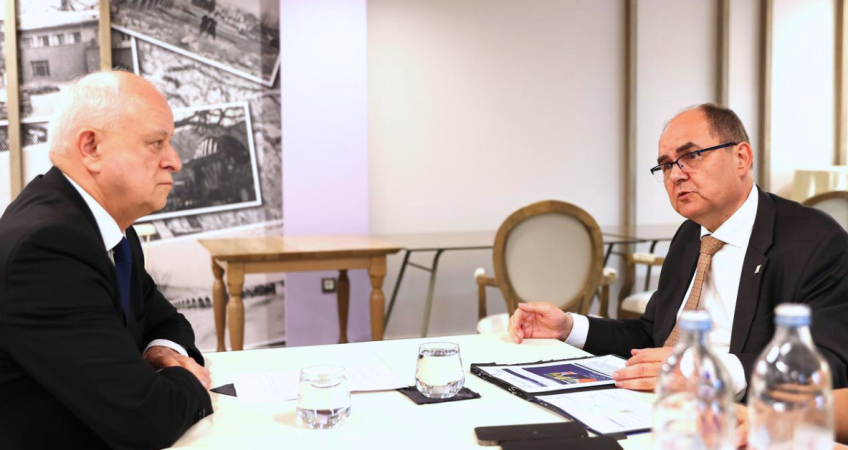


Večernji list: We are witnessing dramatic changes in the global order before our eyes. To what extent do these global processes affect the situation in BiH, and how much could they affect it?
Christian Schmidt: I believe they could have serious consequences. There is a German saying that large waters carry away the smaller ones. I think these “small waters,” meaning BiH and the Western Balkans, do not receive enough attention. When you are dealing with wars and other major challenges, you cannot devote equal attention to everything else. Therefore, you may not even notice that some are doing things they should not be doing. I sometimes hear that some people from Banja Luka – although not all, of course – strongly criticize the European Union, while at the same time I do not hear a clear rejection of ideas of secession. I do not expect there to be some master plan behind all of this, but I do believe there are risks because the consequences are not being sufficiently considered. Once something is damaged or disrupted, it can later be extremely difficult to fix.
Večernji list: Has the EU missed an opportunity to bring BiH closer to its membership, given that it has often set perhaps unnecessarily high criteria?
Christian Schmidt: That is a key and fundamental question. I was among those who advocated for integration and for enabling Bosnia and Herzegovina to adopt the acquis communautaire (editor’s note: adoption of the EU acquis). I also worked extensively on the integration process of the Republic of Croatia, holding detailed discussions with Ivo Sanader, Mate Granić, and other representatives. We examined what needed to be done and how important it was to meet all the requirements. Croatia succeeded because there was strong political will – everyone wanted to obtain the EU membership. I believe that is not entirely the case in Bosnia and Herzegovina. At the same time, we Europeans have an interest in integrating BiH and the Western Balkans for security, economic, and historical reasons.
Večernji list: Have mechanisms been developed for that?
Christian Schmidt: In my personal opinion, they have not been developed. That is why I support the idea of gradual integration. This needs to be discussed and explained extensively in Brussels and in some EU member states, even in my own country, where this idea is not always accepted. We must explain that the situation in BiH is specific and cannot be compared, for example, with Lithuania’s integration. Therefore, I support the ideas of Alexander Schallenberg and Antonio Tajani: let us move forward and begin the integration process. At the Thessaloniki Summit in 2003, the EU promised integration of the Western Balkans. Yet 23 years later, little has been achieved. Only a few countries have joined, and we hope Montenegro, and perhaps Albania, will follow soon. Should citizens of BiH listen to the same promises for another 23 years? Why would young people stay in this country then? That is why I believe all of us together, both domestic and European politicians, must work step by step on this integration, with an understanding of BiH’s specific historical context.
Večernji list: Croatian Prime Minister Andrej Plenković recently said that, after political changes in Hungary, Europe might accelerate the accession of some countries, likely referring to Ukraine. To which extent is this an opportunity for BiH?
Christian Schmidt: It must be clear that attention cannot be focused solely on Ukraine. The EU cannot be satisfied with only Montenegro becoming a member. Nor can one expect that an increase of the number of borders in the Western Balkans will lead to progress. Progress must be gradual, but processes must also be accelerated. No country should be left behind. So, criteria should not be lowered, but we should go step by step.
Večernji list: You said earlier that BiH is a country of missed opportunities. Are these opportunities also being missed due to institutional blockages?
Christian Schmidt: I was a member of Parliament in my country for 31 years. People elect representatives to the Parliament so they can work and make decisions. If you look at the House of Peoples, you see that nothing has been happening for months. As someone from BiH recently told me – those people are not paid to do nothing. I think it is crucial that necessary decisions are made urgently. Last week I had a constructive discussion with Dragan Čović on this very issue.
Večernji list: During his recent visit to Sarajevo and in answering a question about blockages, Austrian President Alexander Van der Bellen said that blockages are also used in Austria as a form of political struggle. They are not unknown in democratic systems?
Christian Schmidt: Blockages are effective, but only if they lead to decisions. If you only have blockages and nothing else, it confuses the people. I believe President Van der Bellen is correct in saying that blockages can be part of the process of political decision-making.
Večernji list: Since I referred to the Austrian President, he also commented on your possible departure from BiH, saying he believes the High Representative will remain for some time and that he is very much needed in this country. There is frequent speculation about your departure?
Christian Schmidt: I remember what I said to Cardinal Pietro Parolin, the Secretary of State of the Holy See, who also asked me how long my mandate would last. I told him that it was not easy for me to answer that question. I added that my mandate is limited by the need for my presence here, and that I will remain as long as I can make a concrete contribution to political development. Allow me to make a personal remark here: I place great hope in the opening of Bosnia and Herzegovina’s accession negotiations with the European Union. Once those negotiations begin, we can start to reduce the influence of the High Representative. That is why I also encourage domestic politicians to make as many decisions as possible. The fact is that when there is no longer a need for the High Representative, it will mean that the country is in a very good state. At that point, there will be no need for the High Representative—and, if I may say so, not for EUFOR either. Citizens deserve that, and they deserve for us to work towards it.
Večernji list: Since you are already encouraging politicians to make decisions independently, will you allow them to decide on one of the most important issues in BiH – disposal of state property – on their own, in the Parliament?
Christian Schmidt: I would very much like them to make that decision. Following Paddy Ashdown and Wolfgang Petritsch, I continued the policy of banning the transfer of state property, and I believe this is necessary due to the constitutional situation. However, from an economic standpoint, I consider it counterproductive. Almost five years ago, I submitted a proposal to Parliament to adopt a State-level law and distribute some of the property among the entities, cantons, and municipalities. I would like to see greater political pressure on local political representatives. If someone reads my Decision on the ban on the disposal of state property carefully, they will see that there is a way out, i.e. a solution. There would be a commission to determine whether there is a public interest, in what manner, and so on. All that is needed is a decision by the Council of Ministers. I truly believe this is necessary and I am ready to support that process.
Večernji list: It is difficult to understand that a decision has been blocked, which is holding back billions in investments in BiH, just because of a single commission. Why are these processes not being accelerated?
Christian Schmidt: I would not burden this conversation with all my attempts to resolve this issue, but citizens are certainly asking the right questions. I cannot change the Dayton Constitution. I would explain it to your readers in this way: Croatia too went through similar challenges and had similar problems, which were resolved through an international agreement between the former Yugoslav Republics (Editor’s note: Agreement on the Issues of Succession of the Former SFRY). This was signed in 2001 and 2002. All the states reached an agreement – Slovenia, Serbia and Montenegro, Croatia, Macedonia, and BiH – and all those countries ratified it. Based on that, the Croatian Parliament adopted a law 25 years ago, and today no one even talks about it. BiH is the only country where this has not been done. The problem is that some people in the Republika Srpska have a different understanding and have an issue with a State-level law in BiH. I would not say that all Serbs in BiH agree with that. There are very capable leaders and political parties in the Republika Srpska, but they have not managed to resolve this issue. We all need to sit down together and reach an agreement. Let me mention one politician who, during his mandate, showed a willingness to engage in dialogue – Mladen Ivanić. And Milorad Dodik as well, when he was younger. I believe that the European integration would be very helpful, as it would put this issue on the agenda and establish it as a clear requirement that must be resolved.
Večernji list: How do you view the Southern Gas Interconnection project, the involvement of American partners, and the establishment of a stock market in Brčko? Are such projects important for the stability and long-term sustainability of Bosnia and Herzegovina? I ask this also in the context of your earlier statement that the United States is showing greater interest in BiH.
Christian Schmidt: Definitely, my answer is yes. I believe this is very important and necessary. Energy supply in BiH must not depend on Gazprom. I will now say something that goes beyond my mandate as High Representative. I would recommend that the European Union also support the Southern Interconnection project. It is fully aligned with EU energy policies, but there is the so-called Green Deal, i.e. Green Plan, which limits the extent to which fossil fuels can be supported. BiH has significant potential, wind, sun, and water, but I believe it needs a combination of different energy sources. That is why I think it is important to have this pipeline. It is connected to Krk in Croatia, which makes it a good bilateral project. I also believe a more pragmatic approach to the Green Deal is needed. Not all energy sources have to be renewable if that is not feasible at this moment. There are strong arguments for a mix of sources, both renewable and fossil, because energy is needed every day, every minute, and it must be available to everyone, and a sufficient supply cannot be ensured solely through solar and wind power. This project perhaps should not be entirely American, but due to a lack of engagement on the European side, it appears that way. If I may add something on renewable energy. We go back again to the issue of state property. For example, there have been efforts by the Elektroprivreda and others to use solar panels on the hills around Mostar. It is remarkable that they have not succeeded. The EU is introducing higher taxes on products made using non-renewable energy sources. The international community must support Bosnia and Herzegovina and be open to the fact that it is necessary to secure energy, whether from fossil or renewable sources. The country must not be penalized for trying to ensure sufficient energy supply.
Večernji list: Although you speak with more passion about economic than political issues, I will still ask a political question. How will voting take place in the elections? Will there be technical novelties introduced, such as scanners, in view of electoral fraud?
Christian Schmidt: I sincerely hope so. The international community is very interested in this issue. We are highly focused on this issue and consider it extremely important to ensure and strengthen the integrity of the electoral process. There is very good cooperation between the OHR, the European Union, the OSCE, and the United States. Last year, I ensured that financial resources were made available. I know that in the coming weeks, up until election day on October 4, we will face various challenges, but we have managed to resolve each one so far. It must be clear to everyone that we will remain committed to this issue and will not give up. I would be very pleased if, when I leave this position one day, it can be said that I contributed to ensuring that the will of the people was respected.
Večernji list: But who is obstructing this? Major political parties?
Christian Schmidt: I will give you a diplomatic answer. When you speak with all the stakeholders in Bosnia and Herzegovina, they all express their support. But as the Bible says, deeds matter more than words. Then we will know who we are dealing with.
Večernji list: Since the beginning of your mandate, relations with Serb political representatives in BiH have been tense, with challenges to your legitimacy and frequent political conflicts. How has this affected your work, and do you believe you also bear some responsibility for this situation?
Christian Schmidt: I think no one can say they have never made a mistake. I will also say that I came to BiH with a very open mind. Let me recall the words of the Austrian Emperor Franz Joseph: “I consider that I have governed well if everyone is equally dissatisfied with me.” Believe it or not, I had very constructive cooperation with Mr. Milorad Dodik. This was when I served as Germany’s Deputy Minister of Defence and later Minister of Agriculture, when Angela Merkel sent me to BiH several times to work on some issues. So, I have had, and still have, contacts with many politicians from the Republika Srpska and beyond, including Serbian President Aleksandar Vučić, whom I have known for 25 years, as well as the Patriarch.
Večernji list: What, then, has caused the problem?
Christian Schmidt: I think that, particularly when it comes to the SNSD and its associates, there is a different understanding of Bosnia and Herzegovina. It seems that BiH is being more tolerated than actively supported, and I believe that it is not the right approach. We had an intense political discussion when Mr. Dodik decided not to respect the Constitutional Court. To be frank, that was also connected with the State property issue.
Večernji list: Some believe that citizens in the Federation are not sufficiently constructive toward Serbs in the Republika Srpska, and that they treat them as unwanted neighbours from a neighbouring country.
Christian Schmidt: I agree with your observation that, in some situations, Serbs have had to do a great deal to be accepted in Bosnia and Herzegovina, but it seems far too easy to use ethnic identity for political purposes. Historically, I am surprised that this region still debates the past so intensely. Everyone speaks about history, but mostly about the past of their own people. I come from a country that placed great emphasis on a sense of guilt and responsibility for the Second World War, and I know how important reconciliation is. I also believe that a visit to Jasenovac should not be a political issue, but an act of paying respect to the victims – a moment to say “never again” and to stand in silence. So, what should be done? I am always open to dialogue and exchange of views, and there have been periods when relations between the Republika Srpska and myself, even during my time as the High Representative, were much better than they appeared in public.
Večernji list: How do you respond to criticism that the international community in BiH has often intervened in political processes, including dismissing officials, and that this has not always respected the democratic will of voters?
Christian Schmidt: Elected officials must be respected, that kind of respect is essential. On the other hand, Dodik himself came to power in that way, during Westendorp’s time. I would say that my role here has not been so limited in the sense that I have refrained from intervening, unlike, for example, Christian Schwarz-Schilling, who passed away last week, or Valentin Inzko. I have made more decisions, but I have not made a single decision to remove any elected official. I believe that, 30 years after Dayton, this is not the time for such measures. What this country lacks is stronger public oversight of politicians, i.e. that citizens determine how politicians behave.
Večernji list: And how do they behave now?
Christian Schmidt: I just spoke with the Chairwoman of the Council of Ministers of BiH, Ms. Borjana Krišto, who is trying to secure funds for Bosnia and Herzegovina from the Growth Plan but is facing various obstructions from the SNSD. If a similar situation occurred in my country or any EU member state, where politicians missed the opportunity for millions or hundreds of millions of euros, they would be held accountable. Citizens would clearly distinguish between politicians like Ms. Krišto, who is doing everything to bring that money to BiH, and those who persistently refuse. So, the question arises: where are the tough questions, and questions that rise criticism, addressed to politicians in BiH?
Večernji list: The time of imposing decisions by the High Representative by using the Bonn powers has still not passed, as these decisions still make sense in light of such obstructions?
Christian Schmidt: Yes, but I believe their role will diminish as the process of European integration progresses. If someone asked me whether I could imagine the High Representative, on the 40th anniversary of the Dayton Peace Agreement, delivering a speech and announcing that he has just imposed two laws, I would say no, I cannot imagine that. I believe the people of this wonderful country can and know that they should make decisions themselves, rather than having someone else do it for them. In my view, the role of the High Representative is also to hold up a mirror to society so that it can see its own reflection. In such case, the Bonn powers would no longer be necessary.
Večernji list: I must ask about the Election Law, which is a particularly important issue for Croats in BiH. When will the Law be changed, and why are you not using the Bonn powers when the spirit of Dayton is being undermined?
Christian Schmidt: We must recognize that there is a mismatch between constitutional rules, the Election Law, and the expectations of certain political leaders. European rules, the Copenhagen criteria, require respect for court rulings, including the Sejdić-Finci judgment, which will also affect the Election Law. The solutions discussed in Neum three years ago were not bad. I believe it is necessary to ensure respect for all constituent peoples in the Federation, without dividing the electorate. This is a complex issue and requires broad support. I would prefer not to be put in a position where I have to use the Bonn powers on this matter. Legislative bodies must take responsibility, including for possible constitutional changes. I also do not agree with Mr. Kovačević’s approach before the European Court of Human Rights. It is difficult for me to imagine BiH having a constitution without a multiethnic approach in the foreseeable future. Still, I do not think everything needs to be rigidly written into law. Let me give a personal example: I come from Bavaria, where Catholics are the majority, while I am a Franconian Lutheran Protestant – a minority, roughly a quarter of the population. Although this is not formally prescribed in the Constitution, there is an unwritten rule of representation – for example, that if the Federal Prime Minister is Catholic, the President is Protestant. So, if certain things are self-understood, that is fine; if not, they must be resolved. I understand this is a sensitive and important issue, but it should be resolved by domestic politicians. I am ready to help in that process.
Večernji list: Given the financial difficulties of the State broadcaster and warnings about its sustainability, do you believe an urgent political solution is needed, and is there a possibility of using the Bonn powers, as a last resort, to secure its funding?
Christian Schmidt: We must not allow the shutdown of BHRT. However, it is difficult to ensure stable financing in a situation where necessary reforms are not being introduced. This may sound somewhat strict, but it must be discussed openly. This issue needs to be put on the agenda, and the solution must be the result of a political decision.