High Representative’s Address to the United Nations Security Council
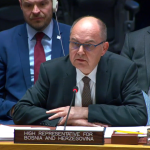
Check against delivery.
Mr. President, Distinguished Members of the Security Council,
Esteemed Chairman of the Presidency of Bosnia and Herzegovina
It is my duty out of the Dayton General Framework Agreement for Peace to give this honourable council a report about the current development in Bosnia and Herzegovina. I will underline that the country is moving along a narrowing path: one that leads either towards institutional sustainability and consolidation, economic revitalization, the rule of law and democratic governance standards, or towards further stagnation driven by political obstruction and a gradual deconstruction of State institutions. While the overall security situation in Bosnia and Herzegovina remains stable, potentially disruptive tensions remain an issue of concern. EUFOR’s presence remains both necessary and reassuring. As a matter of principle, the Dayton institutions, the OHR and EUFOR, remain in place and it is up to the domestic actors to demonstrate political responsibility and local ownership.
At the same time, stability should not be mistaken for institutional health. Even with no imminent security crisis, there is an ongoing crisis of institutional functionality and political responsibility. This affects the quality of governance, economic development and the daily lives of citizens. More concerningly, we are witnessing deliberate attempts to deconstruct state-level institutions by blocking them and preventing them from performing the responsibilities they were created for.
Against this backdrop, my report reflects what I consider to be the four priorities for the current year. First, the preservation of the institutional order established under the Dayton Peace Agreement. Second, restoration of institutional functionality. Third, a resolution of the issue of apportionment of state property and ensuring the timely introduction of election technologies ahead of the General Elections in October 2026.
The Dayton Peace Agreement brought peace to Bosnia and Herzegovina – and this remains valid today. Yet, the constitutional order continues to be weakened from within. Ongoing disagreements over the interpretation and implementation of Dayton, disrespect for the ruling of the highest Court of the country, and, at times, deliberate blockages, continue to affect State institutions, gradually undermining their functionality to the point where the narrative of BiH not being viable becomes a self-fulfilling prophesy.
The progressive deconstruction of State institutions and functions is further exacerbated by a climate of distrust, driven by divisive and degrading narratives that erode the spirit of cooperation essential for a functioning State.
In this context, it is deeply concerning that narratives portraying Bosnia and Herzegovina as a stage for a so-called “clash of civilizations”, along with renewed references to vague and external influences, have re-emerged during the reporting period. Such narratives distort reality. They heighten fear rather than offer solutions for progress and reconciliation. Yes, there remains a lot to do in this context. As well, it remains important to not allow extremist terrorist groups to gain ground.
Steps taken by the leadership of the Republika Srpska in October 2025 helped break the political deadlock and enabled renewed engagement with the international community. However, this apparent de-escalation did not lead to a breakthrough.
On the contrary, the leadership of Republika Srpska continues to question the territorial integrity of Bosnia and Herzegovina and to undermine its stability, and reform prospects. This return to more explicit secessionist themes was recently illustrated by the statements made by Mr. Dodik in the context of the Donja Gradina commemoration. The oscillation between engagement and confrontation undermines trust and hinders any genuine political progress.
Furthermore, the persistent denial of the multi-ethnic character of the entities, particularly within Republika Srpska, has evolved into a systemic exclusion. This structural discrimination not only violates the fundamental rights of non-majority citizens but effectively hinders the sustainable return of refugees envisioned under Annex 7 of the General Framework Agreement for Peace in Bosnia and Herzegovina. The letter sent to you by the Republika Srpska’s Vice President and a group of other Bosniak political representatives outlines a range of institutional and other questions directed in their report against members of minority constituent peoples in the entity, from biased public employment practices, implementation of non-inclusive education and prevention of free expression of different identity, to open glorification of war criminals.
Free and fair elections are the cornerstone of democratic legitimacy. The introduction of safeguard mechanisms to protect election integrity is essential if the October 2026 General Elections are to command public confidence and provide a credible accountability mechanism. The absence of such accountability is one of the reasons for poor governance and state capture.
In close consultation with the member states of the Steering Board of the Peace Implementation Council, the OSCE, and the European Union, and the United States I could prepare these last months the necessary legal and budgetary conditions to provide the opportunity for Bosnia and Herzegovina’s election authorities to increase the integrity and transparency of the October 2026 elections. I’m proud of these achievements. I urge us all not to allow destructive circles to call them into question.
On the issue of State property, my report reiterates the continued lack of progress. This unresolved question has become a major impediment to economic development, infrastructure investment, and long-term growth.
I remain firmly convinced that creating the legal and political conditions for the use of State Property for projects in the public interest is urgent. Opening the Federation of Bosnia and Herzegovina, and the country as a whole, to domestic and foreign investment would not only stimulate economic activity but also help shift the prevailing political dynamic in a positive direction.
I observed that there is a new dynamic stemming out from the decision to construct the so-called “Southern Interconnector” Pipeline designed to deliver Liquefied Natural Gas from Croatia’s KrK terminal to Bosnia and Herzegovina.
So far, Bosnia and Herzegovina’s economy has been struggling with deep structural weaknesses, political uncertainty, and a persistent demographic decline, with election-driven spending likely to keep public finances under pressure in the foreseeable future. Structural blocking of state institutions to take the offers of European Union to enhance integration is a remarkable political attitude directed at the end against the interest of the state and its citizens.
This is particularly concerning, as economic stagnation fuels political radicalization. By contrast, economic development strengthens social cohesion and institutional credibility. It should therefore be a priority for all responsible political actors. Needless to say, I support efforts undertaken by member states of the Peace Implementation Council with a view to providing sustainable solutions to this issue in line with the Constitution.
The media freedom environment, particularly in Republika Srpska, remains a concern. Civil society and independent media are facing a constrained operational environment. These negative developments are obstructing the effective exercise of freedom of expression in the entity.
In this last period, the international community has focused on domestic ownership. Regrettably this approach has not been conducive to genuine engagement and constructive dialogue by domestic political leaders. This situation has obstructed tangible progress, including on Bosnia and Herzegovina’s integration path to the European Union.
Domestic ownership cannot mean institutional neglect. Responsibility must be exercised, not merely asserted. Let me say, as somebody who has been historically socialized by the important experience of the Nuremberg trials, that the rule of law can prevail. There has been a healing power of the ICTY up to this day. The focus has to be on undecided cases of war crimes, some of them at courts in the region.
On the one hand, Bosnia and Herzegovina continues to experience a gradual erosion of institutional cohesion. On the other, there is clear evidence of societal resilience, with citizens often succeeding in moving the country forward.
Citizens continue to live together without broad-based animosity. However, deploying nationalism for political gains fuels emotions and creates fertile ground for division. While extreme voices remain loud, they do not reflect broader society.
With continued support from the international community, citizens, civil society organizations, and responsible politicians can become the catalysts Bosnia and Herzegovina needs to break out of stagnation. There is an urgent need to provide hope for all, a perspective for a common prosperous future, moving beyond dividing lines.
In 1995, this Council helped end a devastating war.
In 2026, the responsibility of the international community might be more subtle, but it is not less important.
Peace, democracy, and constitutional order for Bosnia and Herzegovina should not be left to erode gradually and deliberately. On the contrary, the State institutional structure established under the Dayton Peace Agreement should be preserved and strengthened in a sustainable and irreversible manner.
This will in turn also provide the basis for Bosnia and Herzegovina’s Euro-Atlantic integration.
Let me conclude with a point I raise here on my own behalf.
Under the prevailing circumstances, I took my personal decision to end my mandate as High Representative for Bosnia and Herzegovina based on the Dayton General Agreement for Peace and several United Nations Security Council’s Resolutions and which I have received by Decision of the Steering Board of the Peace Implementation Council in 2021.
As a result of this decision, I have already put the issue of identifying a successor on the agenda of the next meeting of the Steering Board of the Peace Implementation Council. The process to appoint my successor has begun and I plan to depart my role in June.
Since today I was foreseeably presenting for the last time my report in this Council, I would like to thank the distinguished delegates and their countries for their commitment to the implementation of the Dayton Peace Agreement.
It is high time to substantially complete this implementation to bring the Office of the High Representative to a gradual phasing-out according to the “5+2” agenda.
Thank you